









Designer · Author · Strategist · Bangalore

I design human-centricbrands— everything you can see, and a few things you .

Written in braille on the page. Hover or activate to reveal it as text.

The thinking behind the work doesn’t photograph well. So I wrote a book instead.

Twenty-six years across brands, digital products, content systems, and the frameworks that hold them together.

A cleaning company that talks in numbers.A café that sells feelings.A registry that lets strangers verify each other.None of it looks related. All of it is the same job — figuring out what people actually need before they know how to ask for it.

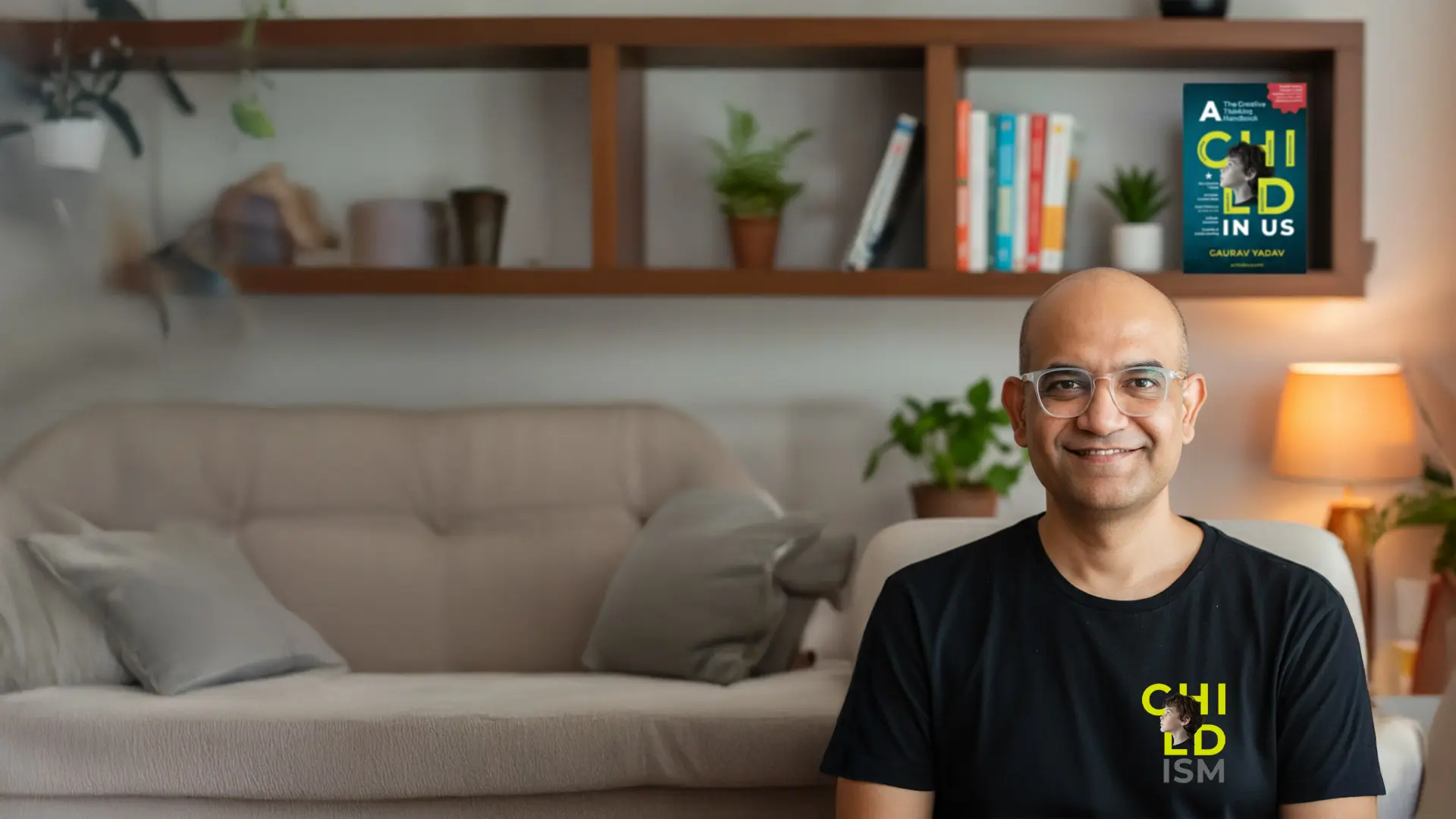
Gaurav Yadav seated in a living room, wearing a CHILDISM t-shirt. A copy of A CHILD in Us stands on the shelf behind him.

That’s the book on the shelf. The framework’s on the shirt.

Twenty-six years in, and the thing I keep relearning is that the best thinking doesn’t look like work. It looks like a five-year-old asking why for the fourth time in a row — and not being embarrassed about it.

Most designers stop at the pixel. I push through to the logic.

  1. 01

    Strategy

    Deconstructing a wicked problem into logic that can actually be solved.

  2. 02

    Design

    Translating that logic into interfaces people don’t have to think about.

  3. 03

    Develop

    Rapid prototyping and front-end architecture that survives contact with the browser.

  4. 04

    Optimize

    Reading heatmaps and analytics to remove cognitive load, not add polish.

  5. 05

    Automate

    Turning what worked into a system that runs without me in the room.

Most projects need two or three of these. Some need all five. I built the CHILD Framework because I got tired of explaining the difference by hand every time.

My Philosophy

Great design isn’t just about aesthetics — it’s about understanding people and their needs. I approach every challenge with empathy, innovation, and a commitment to creating solutions that matter.

  • A Human in the Design Loop

    Design begins and ends with people. By keeping humans at the center, I create experiences that truly connect and evolve with their needs.

  • Human-Centered Design

    Design serves humanity. By placing people at the heart of every decision, I ensure my work aligns with their aspirations and challenges.

  • Human-2-Human Empathy

    Empathy isn’t a value on a slide — it’s a mechanism. Seeing a problem through someone else’s eyes is usually where the actual insight was hiding the whole time.

  • Collaboration is Key

    Great ideas come from everywhere. Co-creating with diverse perspectives enriches the design journey and its outcomes.

  • Iterate, Improve, Evolve

    Design is never done. Feedback and iteration drive solutions that stay relevant and impactful in a changing world.

  • Ethical and Inclusive Design

    Integrity isn’t a checklist item, it’s a design constraint. Privacy, inclusivity, and accessibility aren’t things I add at the end — they’re things I design around from the start.

The long way round

2000 — 2010

The Builder

Learning the internet as it was being invented.

  1. 2000

    Micromark Technologies

    Founded it. Creative Head for sixteen years.

  2. 2002

    National Gallery of Australia

    Designs on Indian miniature paintings, Canberra.

  3. 2003

    V&A · British Library · Ashmolean

    The same body of work exhibited across three institutions in one year.

  4. 2005

    LERN

    Web Manager. Eight years, remote, before that was normal.

  5. Off the record

    Shifted to Bangalore. Got married. Became a father.

2010 — 2020

The Strategist

Where the question changed from “does it look right” to “does it hold together.”

  1. 2010

    Kloudo.com

    Founded it. Product Creator. Also visiting faculty at EABS.

  2. 2013

    SiliconIndia

    Named Top 25 Web Designer of Bangalore and Top 100 Mobile App Designer of India.

  3. 2013

    Redwood

    Product Design Consultant.

  4. 2015

    proveit.in · Manthan

    Product Creator and Strategist. Creative Consultant at Manthan, now Algonomy.

2020 — Present

The Alchemist

The thing and the thinking, finally the same practice.

  1. 2016

    idaete

    Founded it. Ideator and Creative Director. Still is.

  2. 2019

    The CHILD Framework

    Five cognitive instincts: Curiosity, Heuristics, Imagination, Laconic, Deductive.

  3. 2025

    A CHILD in Us

    The Creative Thinking Handbook. Bestseller in Creativity & Self-Help.

  4. 2026

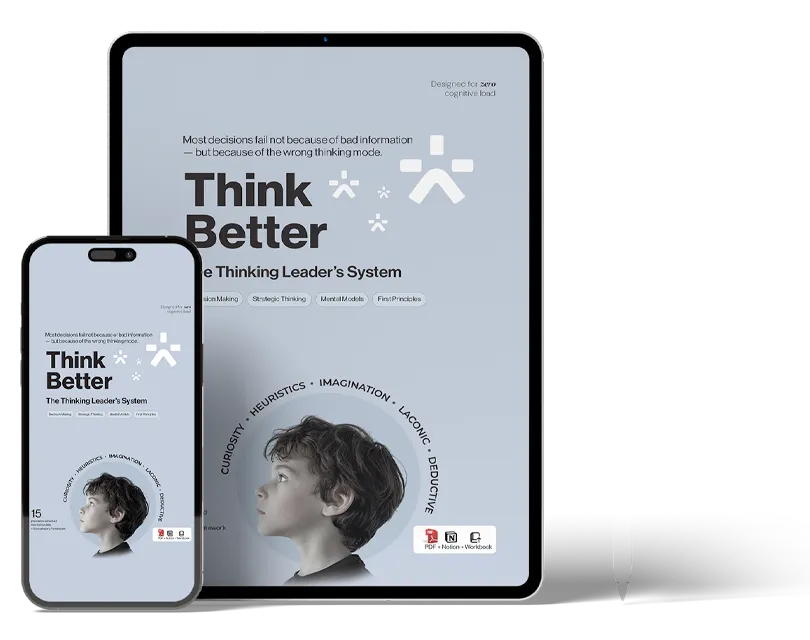
    Think Better

    The Thinking Leader’s System. In progress.

The thinking, written down.

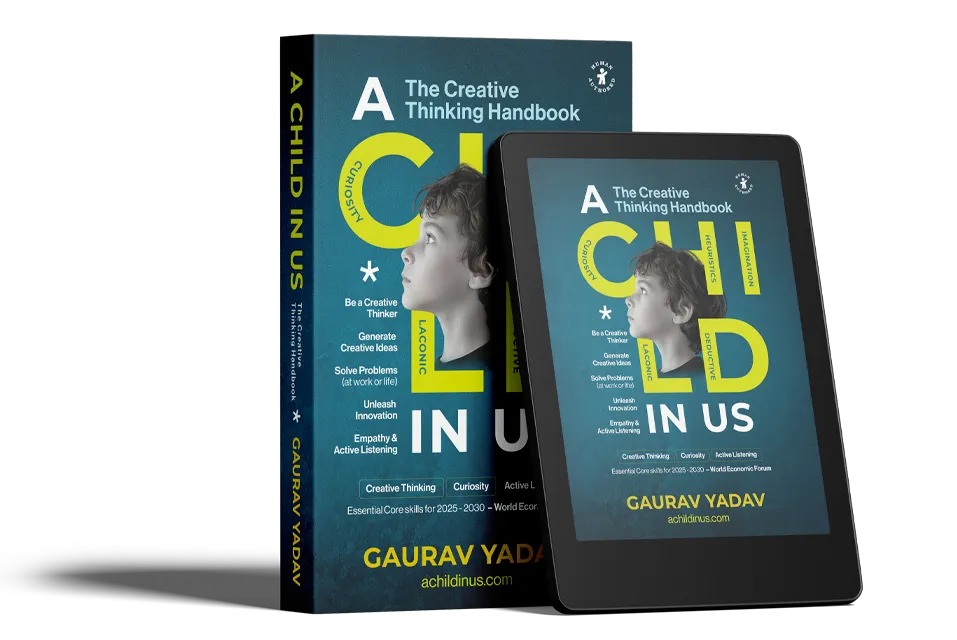
A CHILD in Us: The Creative Thinking Handbook is the manuscript version of every “why does this work” conversation I’ve had in twenty-six years of client meetings. It isn’t a design book. It’s the operating system underneath one.

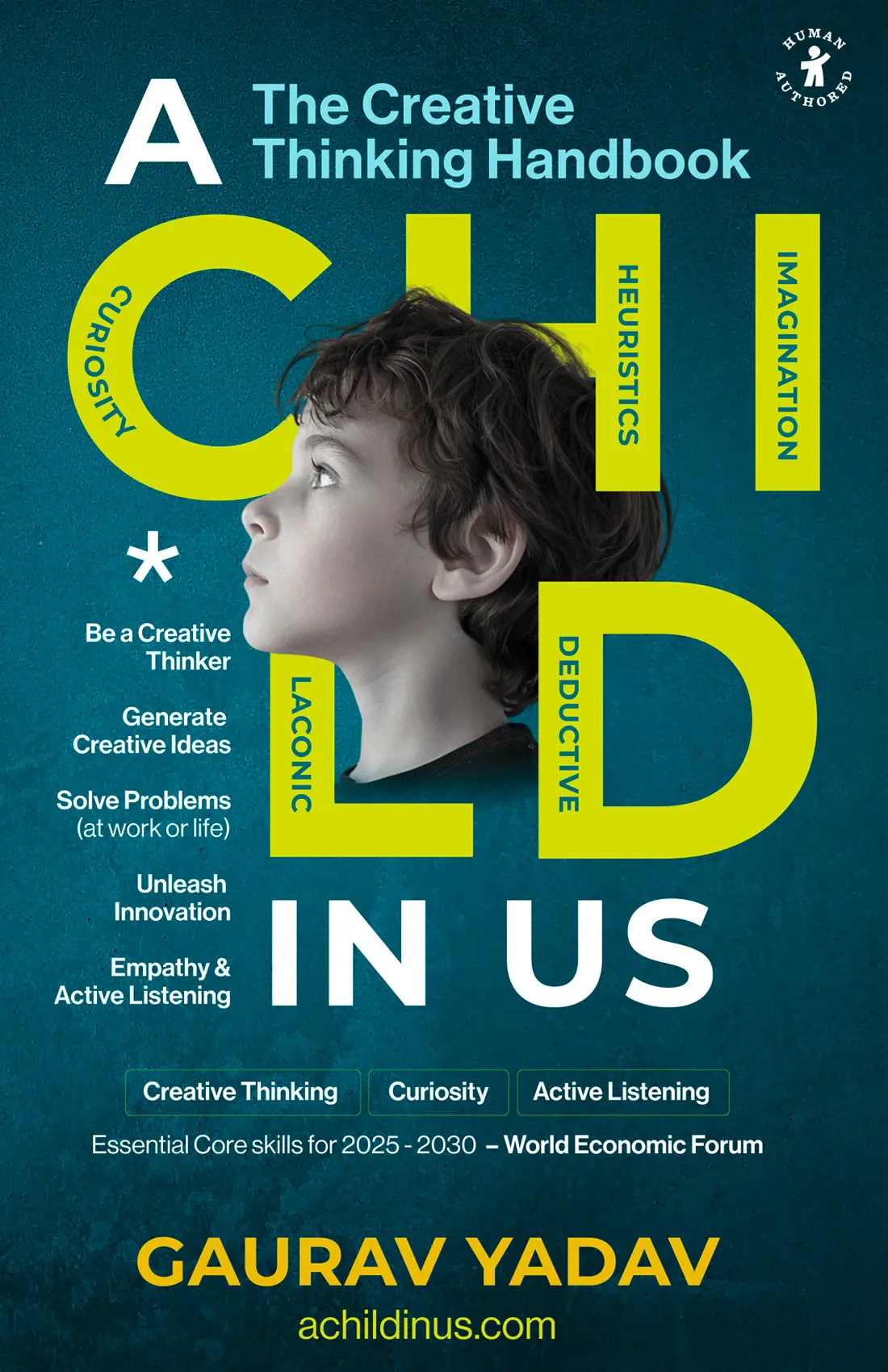
Front cover. A CHILD in Us: The Creative Thinking Handbook by Gaurav Yadav. A boy looks upward through large yellow letters spelling CHILD, each letter labelled with a pillar of the framework — Curiosity, Heuristics, Imagination, Laconic, Deductive.
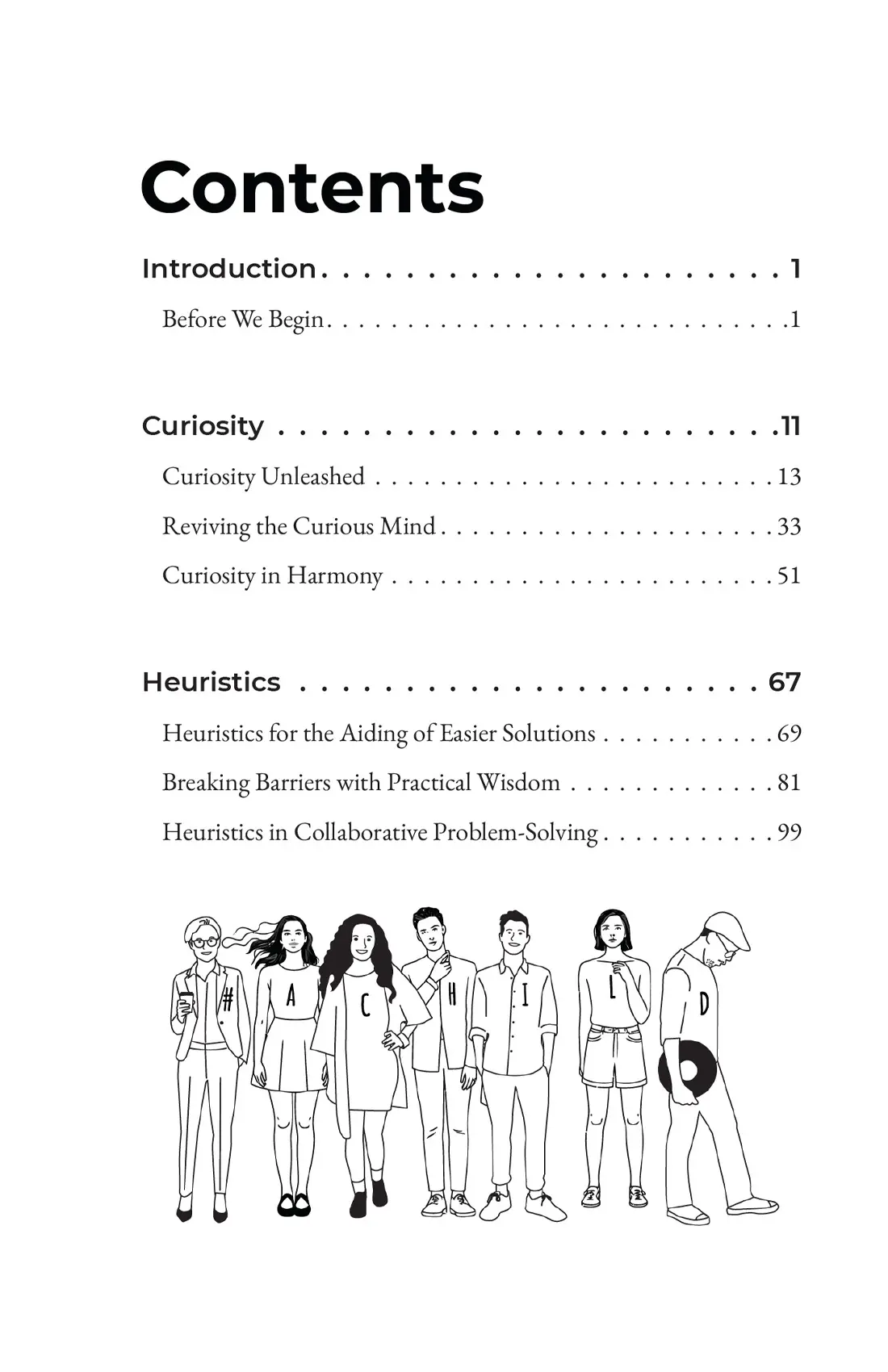
Contents page, listing the Introduction and the opening Curiosity and Heuristics sections, above a line drawing of seven figures whose shirts spell out the book's title.
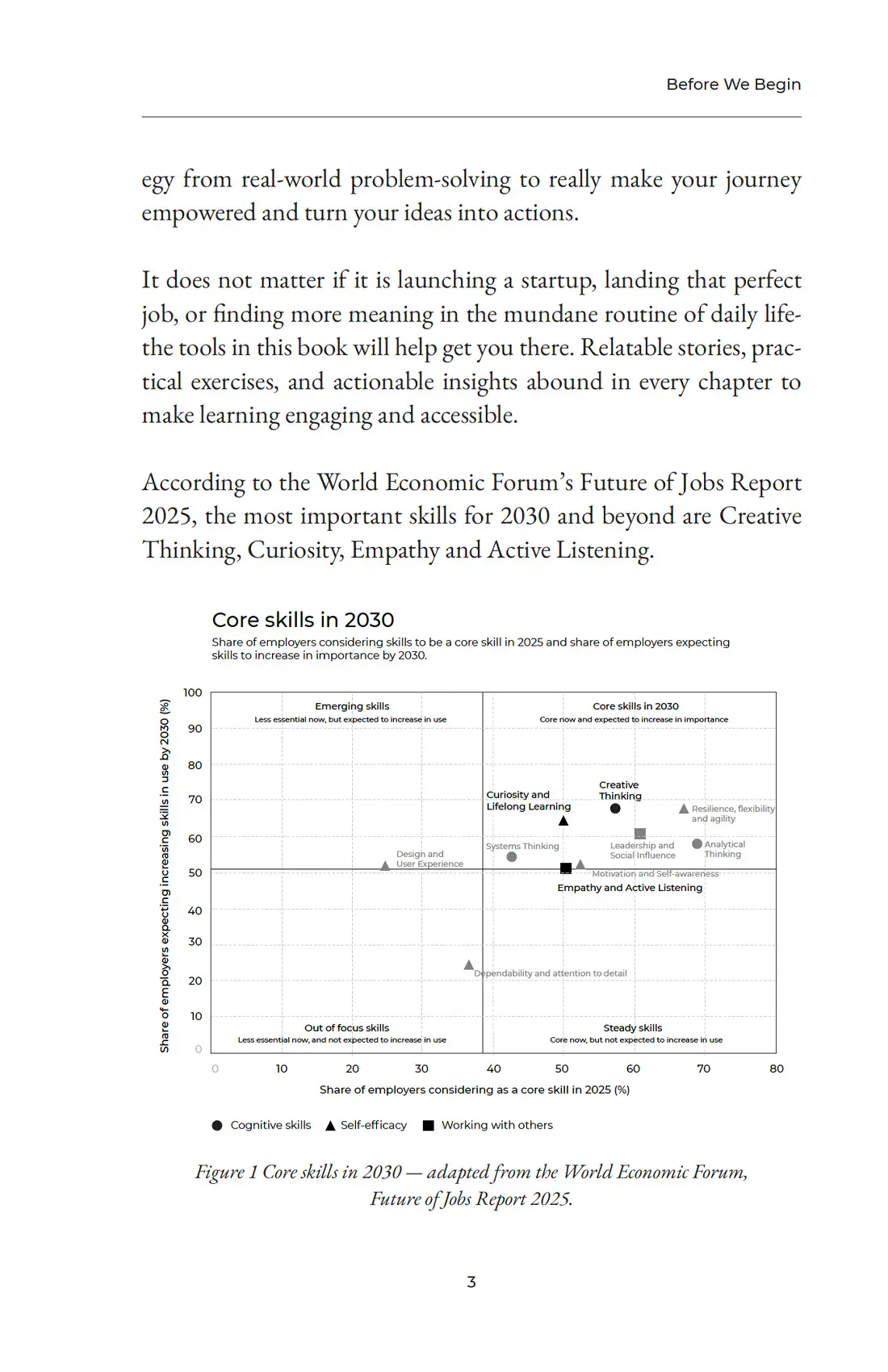
Page 3. A scatter chart adapted from the World Economic Forum's Future of Jobs Report 2025, plotting core skills for 2030 — Creative Thinking, Curiosity and Lifelong Learning, and Empathy and Active Listening all sit in the top-right quadrant.
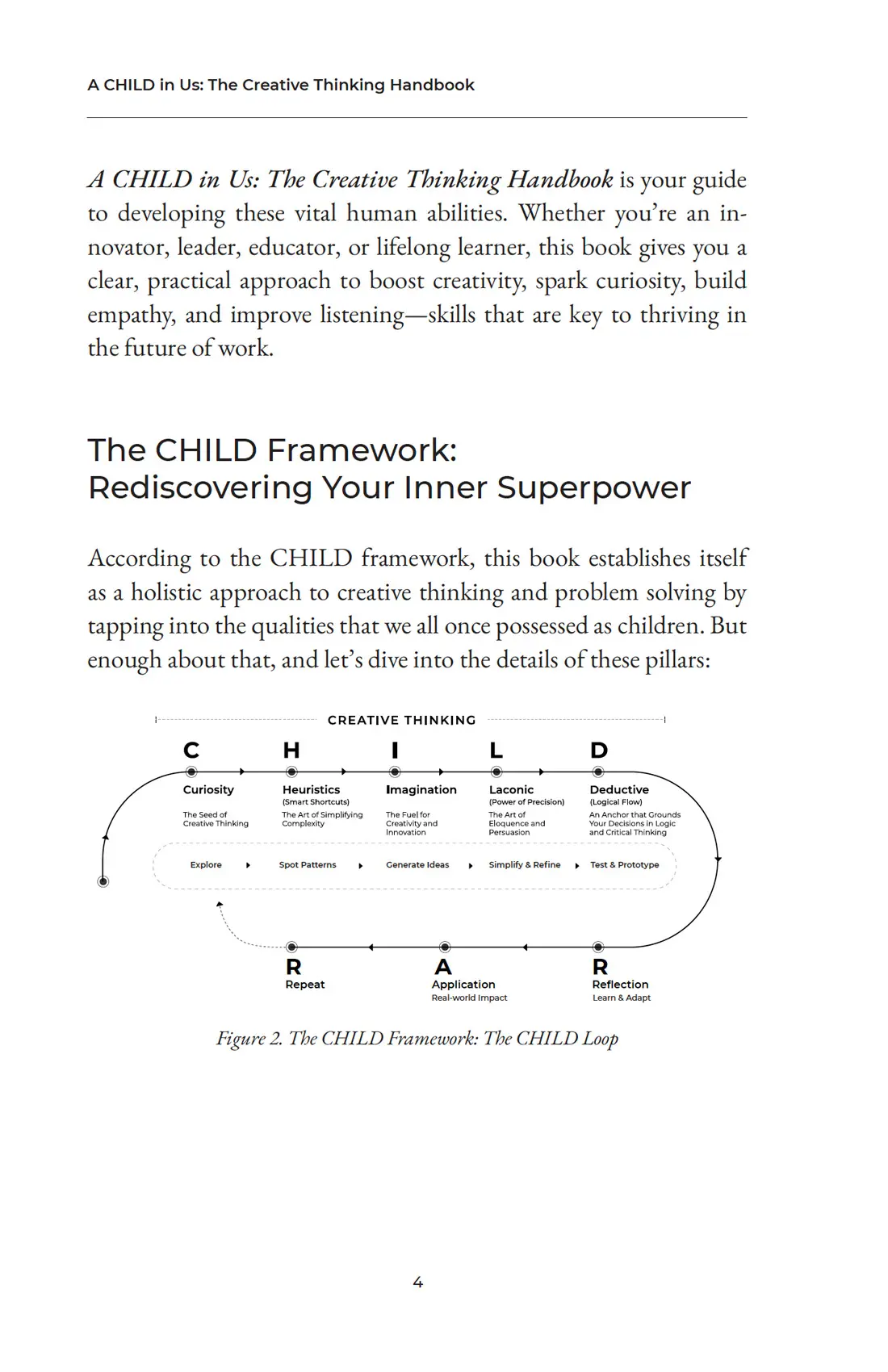
Page 4, opening the section titled The CHILD Framework: Rediscovering Your Inner Superpower. Below it, a diagram of the CHILD Loop running C-H-I-L-D across the top, through Explore, Spot Patterns, Generate Ideas, Simplify and Refine, and Test and Prototype, then looping back via Repeat, Application, and Reflection.
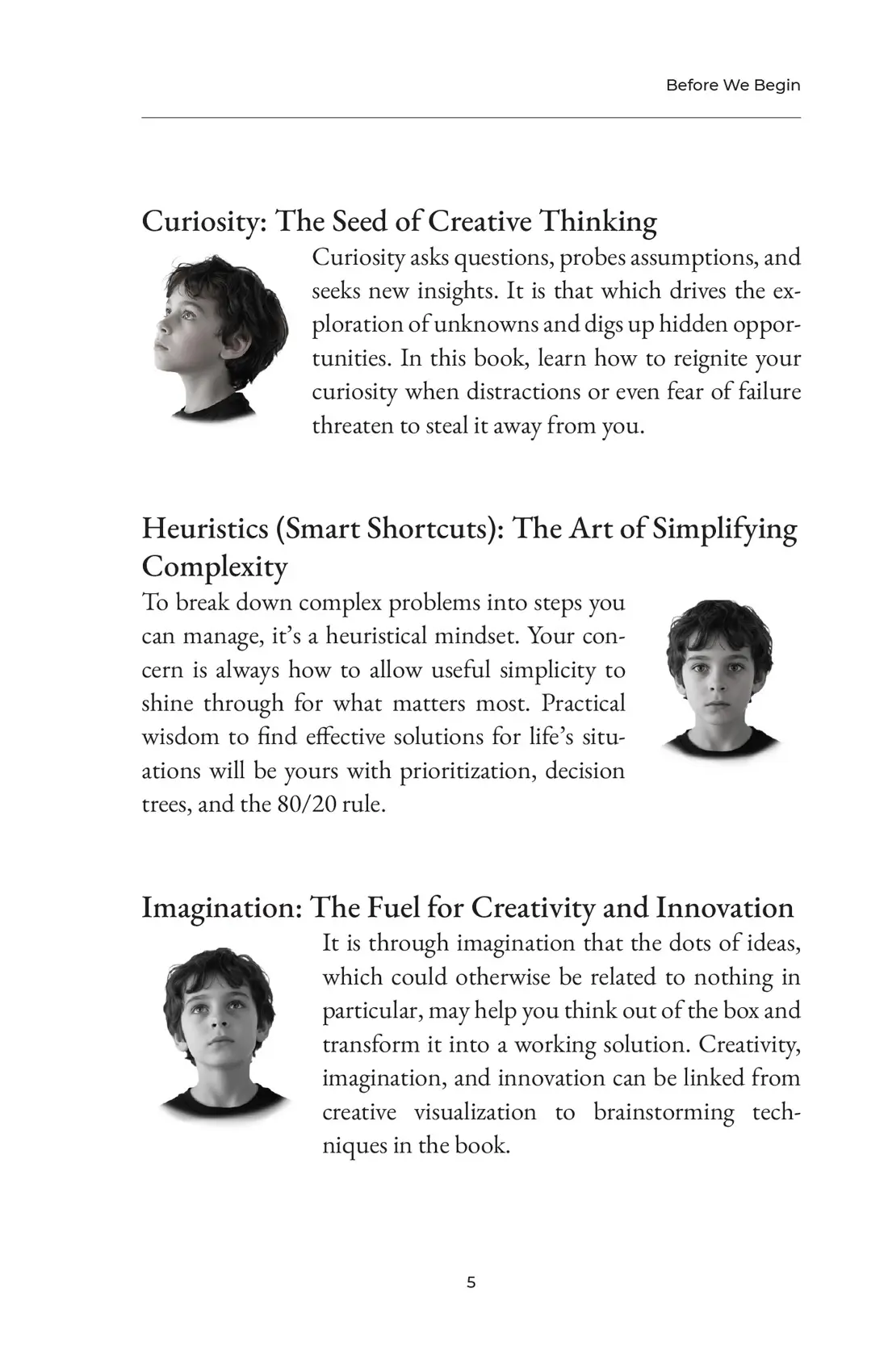
Page 5, defining the first three pillars — Curiosity as the seed of creative thinking, Heuristics as the art of simplifying complexity, and Imagination as the fuel for creativity and innovation — each illustrated with a portrait of a boy.
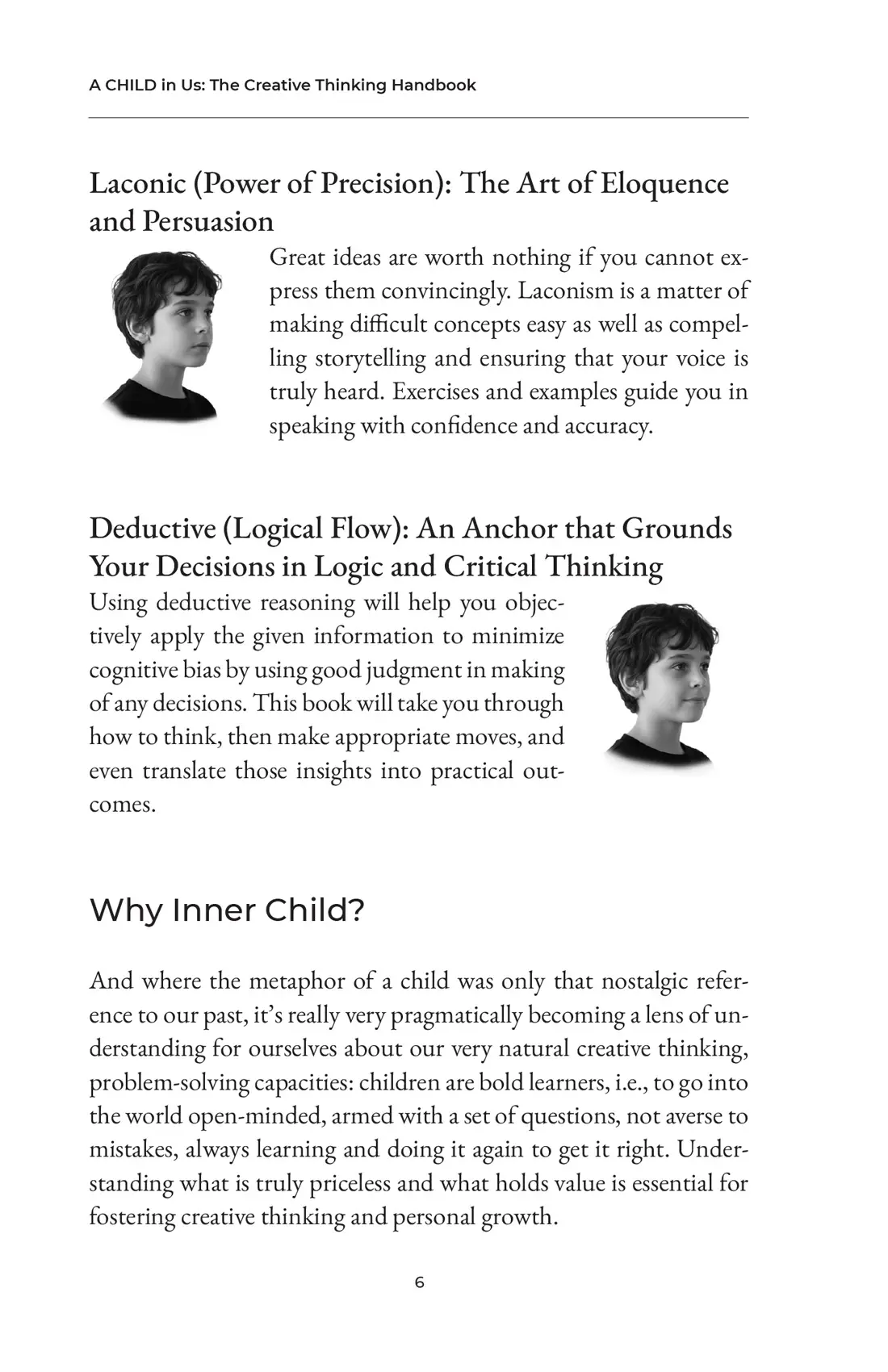
Page 6, defining the remaining two pillars — Laconic as the art of eloquence and persuasion, and Deductive as an anchor grounding decisions in logic — followed by a section asking why the inner child is the right metaphor.
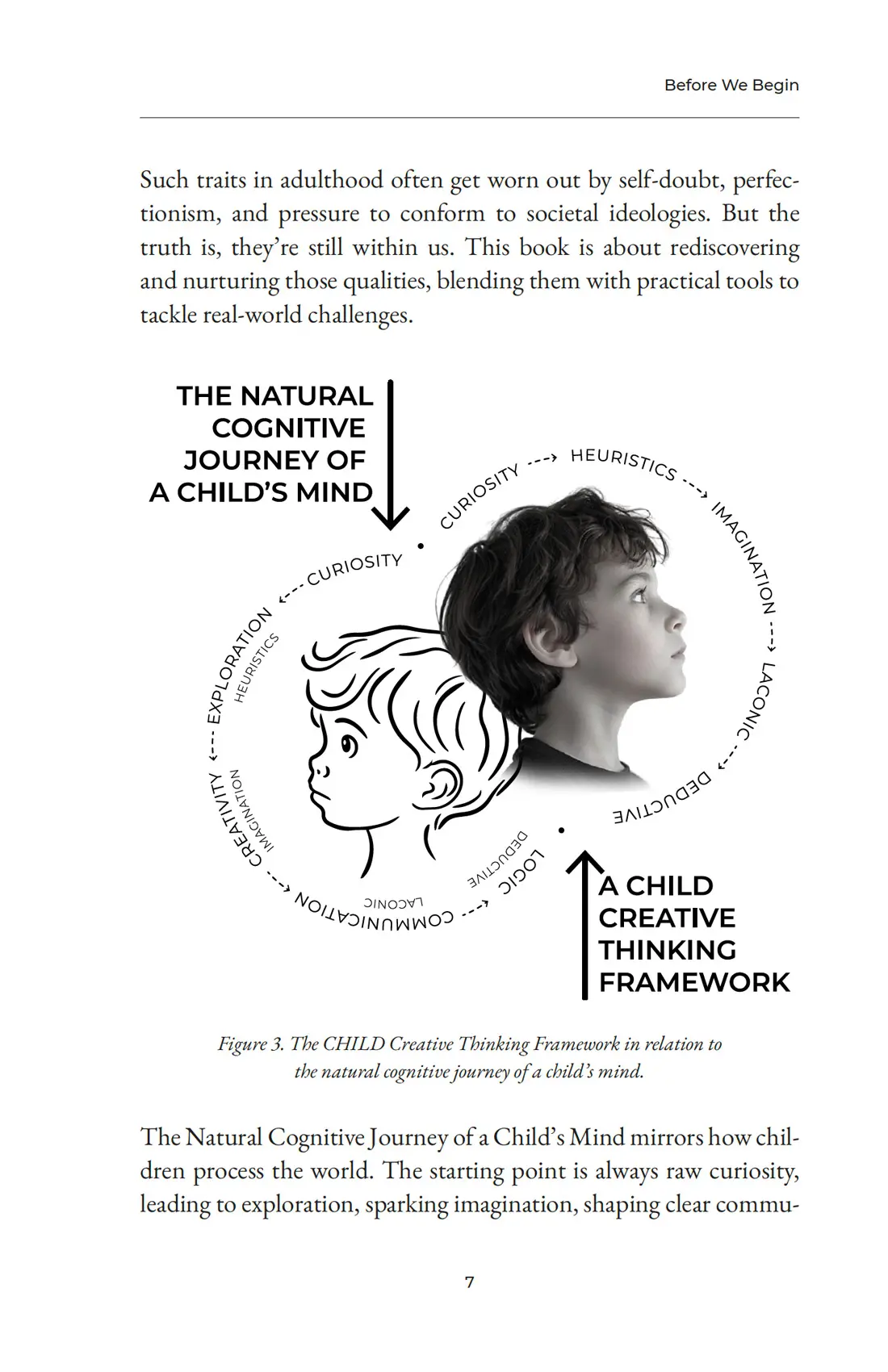
Page 7. A circular diagram setting the CHILD Creative Thinking Framework alongside the natural cognitive journey of a child's mind, running curiosity to exploration to creativity to communication to logic around a photograph and line drawing of a boy's head.
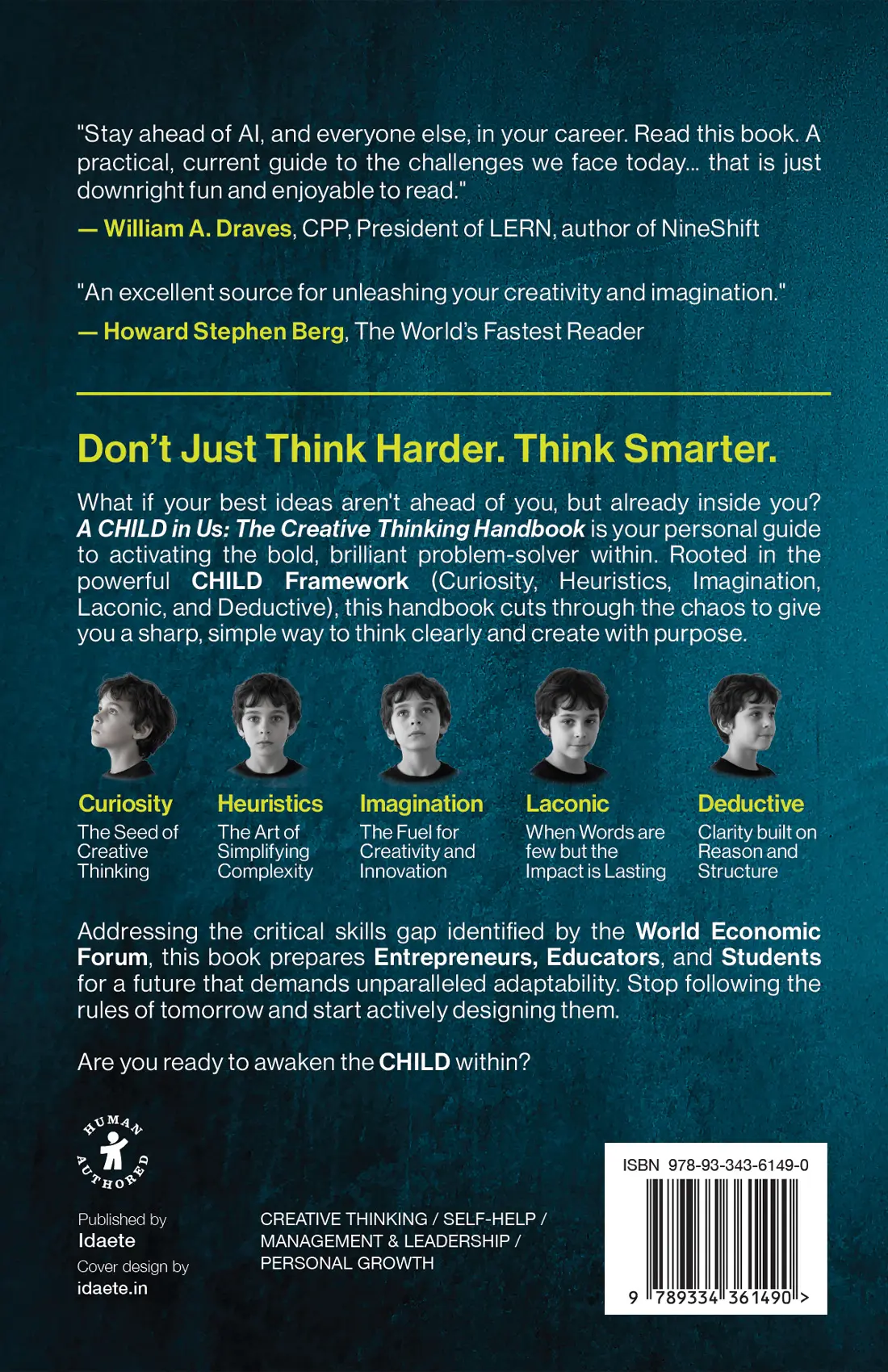
Back cover. Endorsements from William A. Draves and Howard Stephen Berg above the line Don't Just Think Harder. Think Smarter., a summary of the CHILD framework, and the five pillars shown as portraits.
A CHILD in Us — eight pages. Drag a corner to turn.

Got a thing? Let’s make it thinking.

What do your friends call you?

Hey {name} — how do I reach you?

What can I help you with?

Pick as many as apply.

When suits for a call?

Pick any. I’ll send an invite, not a booking link.

Anything I should know before we talk?

One slot, Q3